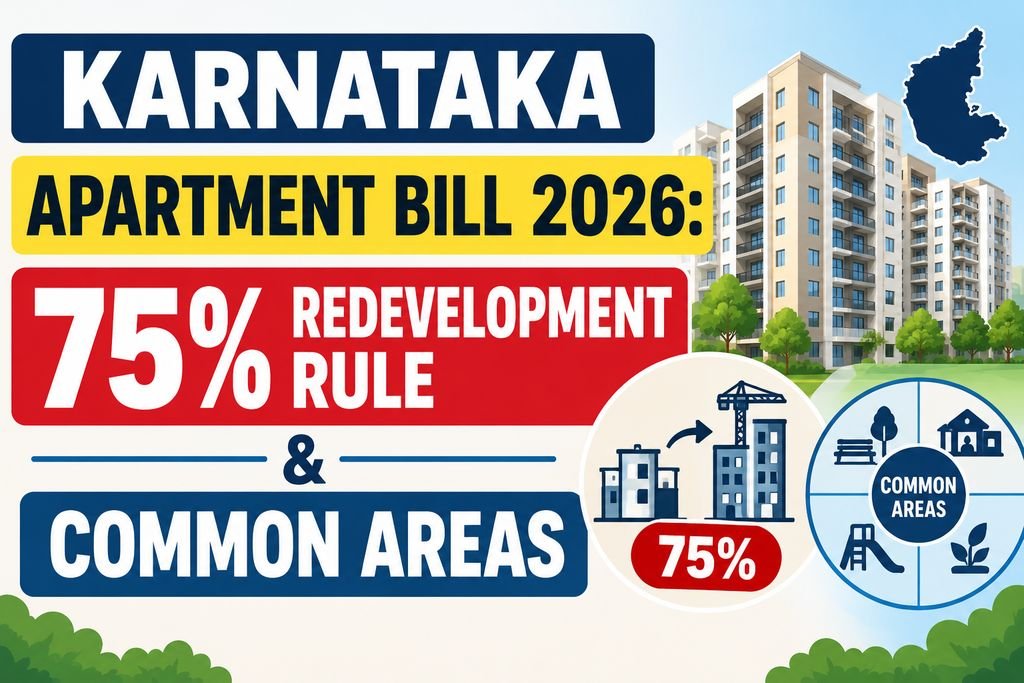
The Karnataka Apartment (Ownership and Management) Bill, 2026 seeks to create a unified legal framework for apartment ownership, management of common areas, apartment associations, dispute resolution and redevelopment of ageing buildings in Karnataka.
The Bill is intended to replace the Karnataka Apartment Ownership Act, 1972 and the Karnataka Ownership Flats (Regulation of the Promotion of Construction, Sale, Management and Transfer) Act, 1972. The government has said that the older framework contains gaps and overlaps with the Real Estate (Regulation and Development) Act, 2016 (RERA).
The Bill has been passed by both the Karnataka Legislative Assembly and Legislative Council, but it is not yet in force and requires the Governor’s assent and commencement notification.
Why Karnataka Needs a New Apartment Law
Apartment ownership in Karnataka has been governed largely by laws enacted in the 1970s, when apartment development was at a much earlier stage.
The government has identified several issues under the existing framework, including uncertainty regarding:
- Ownership of project land and common areas
- Transfer of common facilities from developers to apartment owners
- Formation and functioning of apartment associations
- Maintenance responsibilities
- Dispute resolution
- Safety of ageing apartment buildings
- Recovery of maintenance charges
- Redevelopment of old or structurally unsafe buildings
- Overlap between the existing apartment laws and RERA
The proposed legislation therefore attempts to bring these matters under a single statutory framework.
Ownership of Common Areas and Project Land
One of the significant features of the proposed law concerns common areas and facilities.
The framework provides for ownership of the project land and common areas and facilities by the apartment owners, while the association would primarily be responsible for their management, maintenance and administration.
Common areas can include facilities such as:
- Staircases and corridors
- Lifts
- Terraces
- Basements
- Parks and gardens
- Common parking
- Internal roads
- Water and sewage systems
- Fire-safety installations
- Other facilities intended for common use
The Bill also proposes provisions for deemed conveyance in older apartment projects where the transfer of common areas and land to apartment owners was never completed.
Formation of Apartment Owners’ Associations
The proposed law provides a statutory framework for the formation of associations of apartment owners.
The Bill’s framework is also intended to align association formation with RERA-related requirements. According to the government’s explanatory material, an association of allottees is to be formed within three months after more than 50% of the allottees have booked their apartments in the project.
Existing associations registered under the present framework are proposed to be treated as associations under the new legislation, subject to the transitional provisions.
Developers to Hand Over Documents and Common Facilities
The proposed legislation also places specific responsibilities on promoters.
These include handing over original project documents, plans and service layouts, facilitating formation of the apartment association and maintaining common areas and facilities until the association is formed.
The Bill also contemplates transfer of relevant financial and other records to the association.
For older projects where ownership of common areas has not been transferred, the proposed deemed-conveyance mechanism could become particularly significant.
75% Consent Proposed for Redevelopment
One of the most important provisions concerns the redevelopment of ageing apartment buildings.
Under the proposed framework, redevelopment can proceed with the concurrence of at least 75% of the apartment owners.
This is significant because redevelopment of old apartment buildings can become difficult when some owners do not agree to reconstruction.
The proposed legislation seeks to establish a statutory mechanism for dealing with such situations instead of leaving redevelopment entirely dependent upon individual consent.
What Happens if an Owner Opposes Redevelopment?
The Bill proposes an independent valuation mechanism for owners who do not consent to redevelopment.
The non-consenting owner would be entitled to compensation of at least twice the prevailing market value of the property before acquisition for the redevelopment process, according to the government’s stated framework.
This provision is intended to address the situation where a minority of apartment owners oppose redevelopment even after the required majority has approved it.
At the same time, the actual operation of this mechanism will depend upon the detailed statutory procedure, valuation process and rules framed under the legislation.
Structural Safety of Buildings More Than 30 Years Old
The proposed law also introduces a specific framework for older apartment buildings.
Buildings that have completed 30 years would be required to obtain a structural stability certificate, with subsequent certification every five years.
This provision links the question of redevelopment with building safety, rather than treating redevelopment merely as a commercial decision.
New Dispute Resolution Mechanism
Another major feature is the proposed creation of a dedicated dispute-resolution mechanism.
The framework provides for competent authorities and a two-stage appellate mechanism. The competent authority and appellate authority are proposed to have powers comparable to those of a civil court for specified purposes.
The competent authority would have powers relating to matters such as:
- Examining complaints
- Issuing directions and orders
- Registering and regulating associations
- Scrutinising declarations
- Approving bye-laws
- Ensuring compliance by promoters, associations and apartment owners
- Resolving disputes
This is intended to provide apartment owners with a more specific statutory forum for disputes concerning apartment management and ownership.
How the Bill Relates to RERA
The relationship between the proposed apartment law and RERA is an important issue.
The government’s explanatory material specifically identifies the need to address provisions of the existing Karnataka Ownership Flats law that overlap with RERA and to bring relevant provisions into alignment with the central legislation.
The proposed framework seeks alignment particularly in areas such as:
Definitions, promoter duties, formation of associations of allottees, rights and duties of allottees and execution of deeds transferring common areas and facilities.
Therefore, the proposed legislation is not intended simply to replace RERA with another regulatory system. Rather, it seeks to create a separate framework dealing with apartment ownership, administration, common areas and redevelopment, while aligning relevant provisions with RERA.
Responsibilities of Apartment Owners
The proposed framework would also impose responsibilities on apartment owners.
Owners would be required to:
- Follow the association’s bye-laws
- Use common areas without interfering with the rights of other owners
- Pay maintenance charges and capital contributions
- Maintain their individual apartment properly
- Avoid alterations or works that could affect the safety or soundness of the property
Thus, the proposed law is not limited to protecting owners’ rights. It also establishes duties and responsibilities of apartment owners and associations.
Responsibilities of Apartment Associations
Associations would have responsibilities concerning:
- Maintenance of common areas
- Building upkeep
- Building safety
- Maintenance of accounts and records
- Audit
- Collection and utilisation of maintenance charges
- Registration and implementation of bye-laws
- Community and common facilities
The proposed framework also requires approval from 75% of apartment owners for specified modifications or alterations to the building or common facilities.
Common Capital for Redevelopment
Another proposed mechanism is the creation of common capital.
The framework permits contributions from allottees or apartment owners towards renovation and redevelopment.
This could provide apartment associations with a dedicated financial mechanism for major repairs, renovation and eventual redevelopment of ageing buildings.
What the Bill Could Mean for Existing Apartment Projects
The legislation is particularly relevant to older apartment complexes where:
- The land has not been transferred to apartment owners;
- Common areas remain legally unclear;
- No proper association framework exists;
- The original developer is no longer active;
- Deed of transfer has not been executed;
- The building requires structural assessment; or
- Owners are divided over redevelopment.
The proposed transitional provisions contemplate execution of a separate deed transferring common areas and facilities within 12 months in certain existing projects where apartment ownership was transferred but the common-area transfer was not completed.
Will the Bill Immediately Apply to Apartment Owners?
No.
Although the Bill has passed the Karnataka Legislature, it is not presently in force. It requires the Governor’s assent and a commencement notification before its provisions become operative.
Therefore, apartment owners, associations and developers should distinguish between the proposed statutory framework and the legal provisions currently in force.
Key Takeaway
The Karnataka Apartment (Ownership and Management) Bill, 2026 seeks to address several long-standing issues concerning apartment ownership, common areas, association governance, building safety, dispute resolution and redevelopment.
Among its significant proposals are transfer of project land and common areas to apartment owners, a statutory framework for apartment associations, structural certification for buildings over 30 years old, a dedicated dispute-resolution mechanism and a 75% consent threshold for redevelopment.
The proposed twice-market-value compensation mechanism for non-consenting owners is also likely to be an important aspect of future redevelopment disputes.
However, the Bill should presently be understood as a new statutory framework awaiting commencement, rather than as an already enforceable law