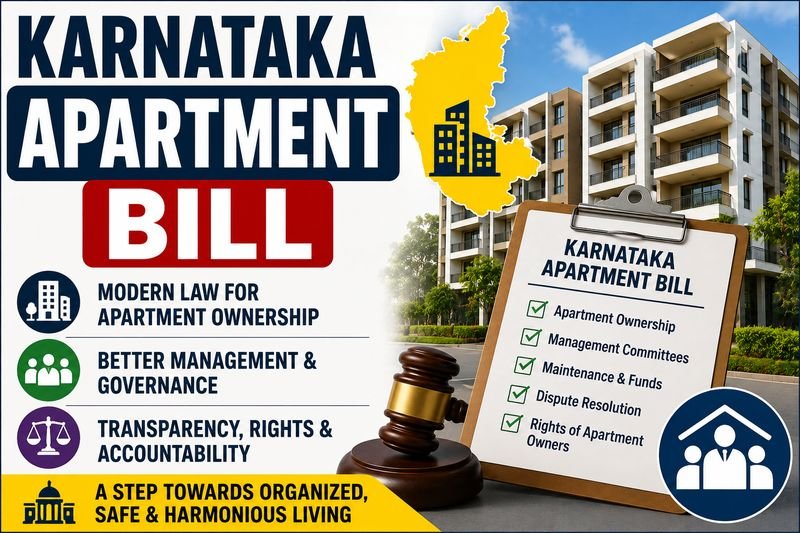
Bengaluru South MP Tejasvi Surya has urged the Karnataka government to strengthen the proposed Karnataka Apartment (Ownership and Management) Bill, 2026, arguing that the new legislation should complement and strengthen the Real Estate (Regulation and Development) Act, 2016 (RERA) rather than create a parallel regulatory framework.
The intervention comes at a time when Karnataka is considering a comprehensive overhaul of its apartment ownership laws. The draft legislation seeks to replace the decades-old Karnataka Apartment Ownership Act, 1972 and Karnataka Ownership Flats Act, 1972, with a unified framework governing apartment ownership, management, common areas and redevelopment.
Surya has specifically highlighted that the biggest problem confronting apartment owners is not necessarily the absence of legislation, but weak enforcement of rights that already exist.
Tejasvi Surya calls for stronger RERA integration
In his representation to Karnataka Chief Minister D.K. Shivakumar on July 31, Surya welcomed the government’s decision to introduce a new apartment ownership law but stressed that the proposed legislation must work in harmony with RERA.
His central concern is that apartment owners should not have to navigate two overlapping legal regimes for rights that are already recognised under RERA.
The proposed legislation should therefore clearly establish how the rights of apartment owners under RERA will be implemented at the ground level.
This is particularly important in relation to common areas, project land, title documents, maintenance funds and apartment associations.
The Karnataka government unveiled the draft Bill in July and has indicated that it is intended to modernise apartment governance and address long-standing problems concerning ownership, management and redevelopment.
The real issue: Transfer of common areas
One of the most important issues highlighted by Surya is the transfer of common areas and the underlying land to apartment owners’ associations.
Under Section 17 of RERA, the promoter is required to execute the necessary conveyance and transfer the title in the project and common areas in accordance with the applicable law.
However, in practice, apartment owners in several projects continue to face delays in obtaining:
- Title to common areas
- Transfer of project land
- Khata and revenue records
- Maintenance and sinking funds
- Project documents
- Common facility records
- Control over common infrastructure
Surya has therefore suggested that the proposed Karnataka Apartment Bill should make the transfer of common areas and the underlying land a time-bound statutory obligation.
This would move the law beyond merely recognising apartment owners’ rights and create a mechanism to ensure that those rights are actually implemented.
Why Section 17 of RERA is important
Section 17 of RERA is particularly significant because ownership of an apartment does not merely concern the four walls of the individual unit.
An apartment owner also has an interest in the common areas and facilities and, depending on the applicable legal structure, the underlying land.
The problem arises when a builder hands over individual apartments but continues to retain control over the wider project.
This can create disputes over:
Common areas → Land title → Maintenance funds → Documents → Association control → Redevelopment
Surya’s proposal seeks to address this implementation gap by ensuring that the proposed state legislation actually operationalises the rights already contemplated under RERA.
Apartment owners need more than possession of the flat
A recurring problem in apartment projects is the assumption that the developer’s responsibility ends once physical possession of individual flats is handed over.
That is not necessarily the end of the promoter’s statutory obligations.
A project also involves the transfer and management of common areas, facilities, infrastructure, documents and financial resources.
Recent K-RERA proceedings have similarly demonstrated the importance of completing promised amenities and transferring project assets and funds to authorised apartment owners’ associations.
The proposed legislation could therefore provide a clearer mechanism for completing this transition from builder-controlled project to owner-controlled apartment community.
Time-bound transfer could change apartment governance
One of the most important recommendations is the introduction of a specific statutory deadline for transferring common areas and land.
At present, disputes can continue for years when developers fail to complete conveyance or transfer documents.
A time-bound mechanism could potentially require the promoter to:
- Form and register the apartment owners’ association
- Execute the necessary conveyance documents
- Transfer common areas
- Transfer the underlying land interest
- Hand over title and project documents
- Transfer maintenance and sinking funds
- Provide audited accounts
- Complete the transition of project management
Such provisions would make the new legislation more effective from the perspective of ordinary apartment owners.
Avoid creating a parallel RERA framework
Surya’s broader argument is that the proposed Karnataka law should not duplicate RERA.
RERA already provides a comprehensive regulatory framework governing promoters, allottees, project registration, disclosures, construction obligations and transfer of common areas.
The state apartment law should instead address areas where state-level legislation is required to make those rights operational.
In other words, the proposed legislation should answer a practical question:
How will an apartment owner’s RERA rights actually be implemented after possession?
This distinction is important because overlapping laws can create uncertainty about which authority has jurisdiction over a particular dispute.
Proposed Bill seeks wider reform of apartment ownership
The draft Karnataka Apartment (Ownership and Management) Bill, 2026 is broader than the issue of common-area transfer.
The proposed legislation seeks to modernise apartment ownership and management across Karnataka and provide a framework better suited to the state’s rapidly expanding apartment sector. Reports on the draft indicate provisions concerning ownership rights, apartment associations, maintenance, redevelopment and structural safety.
Among the proposals reported in relation to the draft are mechanisms for redevelopment of ageing buildings and structural safety requirements for older apartment complexes. Buildings reaching 30 years of age are proposed to undergo structural stability certification, followed by periodic inspections.
The draft has also been described as providing clearer recognition of apartment owners’ interests in the land beneath the project, including corresponding revenue-record implications.
Why the reform matters to Bengaluru apartment owners
Bengaluru has experienced enormous growth in apartment development, with thousands of residential complexes and millions of apartment residents.
The scale of this development means that issues concerning ownership, common areas, maintenance, association governance and redevelopment are no longer isolated disputes between individual buyers and builders.
They have become major urban governance issues.
A modern apartment law therefore needs to address the entire life cycle of an apartment project:
Purchase → Construction → Possession → Association formation → Common-area transfer → Maintenance → Repairs → Redevelopment
The proposed Bill could become particularly significant for older apartment complexes where questions of title, maintenance responsibility and redevelopment have become increasingly complicated.
Association formation must be effective
Another important aspect of apartment governance is the creation of a properly functioning Apartment Owners’ Association.
An association should not merely exist on paper. It needs to have effective control over the common facilities and the financial resources required to maintain them.
The proposed framework should therefore clearly establish:
- When an association must be formed
- Who is responsible for forming it
- When the promoter must transfer control
- What documents must be handed over
- How maintenance funds are transferred
- How accounts are audited
- What happens if the promoter fails to cooperate
These provisions could significantly reduce disputes between apartment owners and developers.
What homebuyers should watch for
For existing and prospective apartment owners, the proposed reforms could have important consequences.
Buyers should particularly examine whether their project has received:
Registered conveyance → Common-area transfer → Land title transfer → Association formation → Khata/revenue records → Maintenance fund transfer → Project documents
A registered sale deed for an individual apartment does not necessarily resolve every issue concerning the project’s common property and management.
Apartment owners should therefore preserve agreements, sale deeds, sanctioned plans, correspondence, maintenance records, payment details and documents relating to association formation.
Government consultation is an important opportunity
The Karnataka government has opened the proposed legislation to stakeholder feedback. The government has indicated that apartment owners and resident associations can provide suggestions before the Bill is finalised.
This consultation is particularly important because the effectiveness of the legislation will depend not merely on the rights it declares but on the enforcement mechanisms it creates.
A law that recognises ownership rights but does not provide a practical mechanism for enforcing them may not solve the problems currently faced by apartment owners.
The larger RERA question
The debate surrounding the Karnataka Apartment Bill also highlights a larger issue concerning RERA implementation across India.
RERA created important rights for homebuyers, but the effectiveness of those rights ultimately depends upon enforcement.
Section 17 may recognise the importance of transferring common areas, but apartment owners need a clear process, a defined timeline and an accountable authority to ensure that the transfer actually occurs.
This is why the proposed Karnataka legislation could become an important opportunity to bridge the gap between legal rights and practical enforcement.
What Tejasvi Surya’s proposal could mean
If the recommendations are incorporated effectively, apartment owners could receive greater certainty regarding:
1. Common-area ownership
Developers could face a clearly defined obligation to transfer common areas.
2. Land rights
The underlying land interest of apartment owners could be more clearly recognised and transferred.
3. Association control
Apartment associations could receive effective control over the project after the prescribed stage.
4. Financial transparency
Maintenance, sinking and other project-related funds could be subject to clearer handover and accounting requirements.
5. RERA coordination
The state apartment law could operate as an implementation mechanism rather than competing with RERA.
6. Time-bound compliance
Developers could be required to complete critical post-possession obligations within defined timelines.
Conclusion
The proposed Karnataka Apartment (Ownership and Management) Bill, 2026 presents an opportunity to address one of the most persistent problems faced by apartment owners: having ownership of an individual flat without effective control over the larger property of which that flat forms a part.
Tejasvi Surya’s call for the Bill to complement RERA rather than create a parallel framework is therefore significant.
The real test will be whether the final legislation provides clear timelines, mandatory compliance, transparent accounts, effective association formation and enforceable transfer of common areas and land.
For apartment owners, the objective should be simple: buying a flat should ultimately result not merely in possession of the apartment, but in full and enforceable ownership rights in the apartment community and its common property.
The draft Bill is still a proposed framework and may change before enactment. Its final provisions, rules and implementation mechanisms will determine the extent to which these proposed reforms translate into practical rights for apartment owners.