

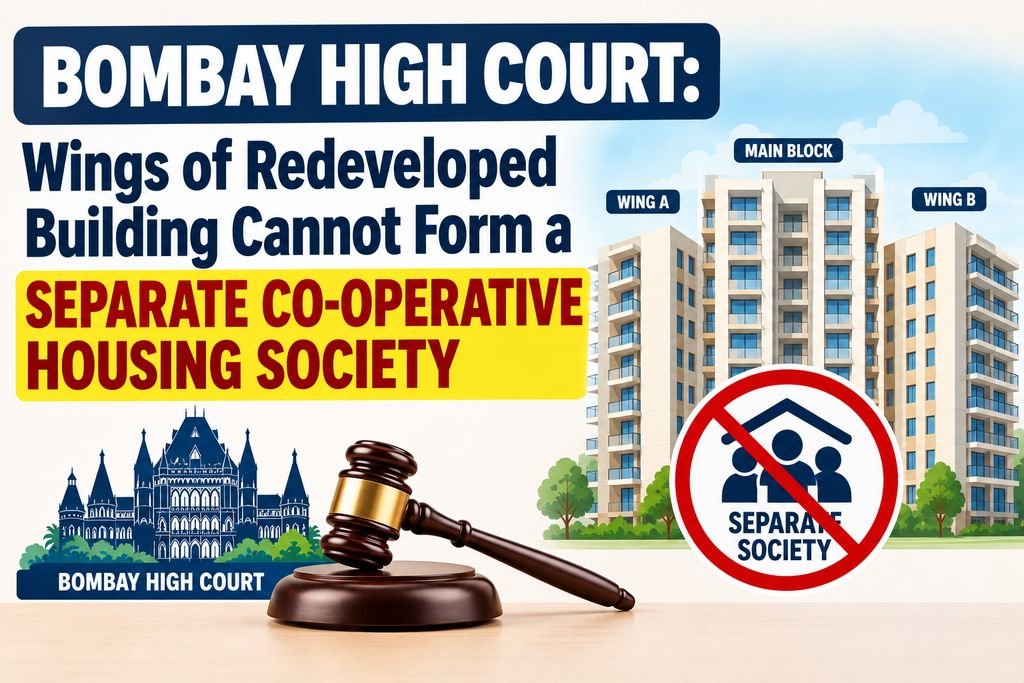
The Bombay High Court has ruled that residents of different wings of an integrated redeveloped building cannot form a separate co-operative housing society by bypassing the statutory procedure prescribed for the division of an existing society.
Justice Sandeep Marne, in a judgment dated 18 September 2026, quashed the registration of Atharva Co-operative Housing Society Ltd., which had been formed by flat purchasers in Wings A and B of a redeveloped complex in Prabhadevi, Mumbai.
The Court held that residents seeking separation from an existing housing society must follow the procedure prescribed under Sections 17 and 18 of the Maharashtra Co-operative Societies Act, 1960 (MCS Act). They cannot rely on the fresh registration mechanism under Section 9 to achieve indirectly what the law regulates through a specific statutory process.
The judgment arose from a petition filed by The Swa-Griha Co-operative Housing Society Ltd., which challenged the registration of Atharva CHS.
Registration Granted by Deputy Registrar in February 2025
The Deputy Registrar had granted registration to Atharva Co-operative Housing Society Ltd. in February 2025. The registration was subsequently upheld by the Joint Registrar and the Maharashtra State Cooperation Minister.
Swa-Griha CHS challenged the registration before the Bombay High Court, contending that the formation of a separate society was contrary to the statutory framework governing the division of an existing co-operative society.
The High Court accepted the challenge and quashed Atharva CHS’s registration.
The decision clarifies that the registration of a new society cannot be used as a substitute for the statutory procedure governing the division of an existing society, particularly where the building and its facilities continue to operate as an integrated complex.
Background: Redevelopment of the Prabhadevi Complex
The dispute arose from a redevelopment project involving Swa-Griha Co-operative Housing Society Ltd., which was established in 1968 on MHADA land and subsequently undertook redevelopment along with adjoining plots.
Developer Sugee Developers Pvt. Ltd. constructed a multi-wing building comprising 240 flats across Wings A, B, C and D.
The original members of the society and MHADA allottees occupied Wings C and D, while purchasers of flats in Wings A and B sought to establish a separate co-operative housing society.
The residents seeking separation cited management-related grievances and differences between the two groups of residents.
However, the Court held that such grievances did not justify bypassing the statutory procedure prescribed for dividing an existing society.
Sections 17 and 18 Govern Division of an Existing Society
A central issue before the Court was whether purchasers in particular wings of a redeveloped building could obtain registration of a separate society under Section 9 of the MCS Act when an existing society already covered the integrated property.
The Court emphasised the distinction between registering a new society and dividing an existing one.
Under the statutory framework considered by the Court, Sections 17 and 18 provide the mechanism for the division and reorganisation of an existing co-operative society.
The Court observed that the detailed procedure prescribed for division could not be bypassed by applying for fresh registration under Section 9.
It held that allowing such a course could defeat the legislative framework and create overlapping jurisdictions over the same property.
The ruling reinforces the principle that the statutory route for separation must be followed even when residents have genuine disagreements with the existing society.
Court: Section 9 Cannot Be Used to Fragment an Existing Society
The High Court made it clear that fresh registration under Section 9 cannot be used as an indirect method of fragmenting an existing co-operative society.
The Court observed that where a housing society has already been formed for a building, residents cannot simply apply for registration of another society for selected wings without following the legally prescribed division procedure.
The concern was not merely the creation of another administrative body. Separate societies within an integrated building could raise questions about the management of common facilities, property rights and the authority to make decisions affecting the entire complex.
The Court therefore rejected the attempt to achieve separation through fresh registration.
Social or Economic Differences Do Not Justify Separate Registration
Another important observation concerned the differences between residents of Wings A and B and those occupying Wings C and D.
The Court noted that purchasers had acquired their flats with knowledge of the existing arrangement and could not subsequently seek to establish a separate society merely on the ground of social or economic differences between residents.
The judgment indicates that differences in background, preferences or management expectations do not, by themselves, override the statutory requirements governing the organisation of co-operative housing societies.
Residents who wish to restructure an existing society must pursue the procedure recognised by law rather than create a separate legal entity through an alternative registration route.
Common Facilities Reinforced the Integrated Nature of the Building
The Court also considered the physical and functional relationship between the four wings.
It noted that the building continued to share several important facilities, including:
- A 10-level podium parking area
- Common entry gates
- Water tanks
- Electricity connections
- Recreational spaces
These shared facilities demonstrated that the wings formed part of an integrated development.
The existence of common infrastructure was relevant because dividing the society could affect the administration, maintenance and use of facilities serving residents across the complex.
The Court considered this integration an additional reason why the residents could not simply establish a separate society without following the statutory division procedure.
Why the Registration Was Quashed
The High Court quashed Atharva Co-operative Housing Society Ltd.’s registration after finding that the separate registration route could not be used to circumvent the legal procedure for dividing Swa-Griha CHS.
The registration had initially been granted by the Deputy Registrar in February 2025 and subsequently upheld by the Joint Registrar and the State Cooperation Minister.
The High Court’s ruling set aside that registration, emphasising the need to comply with the statutory framework under the MCS Act.
Implications for Redeveloped Housing Societies in Maharashtra
The judgment has significance for large redevelopment projects involving multiple wings, towers or buildings under a single co-operative housing society.
In such projects, some residents may seek separate management arrangements because of disputes over maintenance, expenditure, amenities or the functioning of the managing committee.
However, a separate wing or tower does not automatically acquire the legal right to form an independent co-operative housing society merely because its residents have different preferences or grievances.
Where an existing society covers an integrated development, residents seeking separation must examine and follow the applicable statutory procedure.
The ruling is particularly relevant where different wings continue to depend on common parking facilities, entrances, utilities, water infrastructure or recreational amenities.
What Housing Societies and Flat Purchasers Should Understand
The decision highlights several practical points:
- Existing society structure matters: Residents must consider whether the building or integrated development is already covered by a registered co-operative housing society.
- Fresh registration is not a substitute for division: Section 9 cannot be used to bypass the statutory process applicable to the division of an existing society.
- Follow the prescribed legal procedure: Residents seeking separation must examine the requirements under Sections 17 and 18 of the MCS Act.
- Shared amenities are significant: Common parking, access, utilities and recreational facilities may reinforce the integrated character of a development.
- Resident differences are not enough: Social, economic or management-related differences do not automatically justify forming a separate society outside the statutory framework.
The Bombay High Court’s decision in the dispute between Swa-Griha Co-operative Housing Society Ltd. and Atharva Co-operative Housing Society Ltd. reinforces the statutory framework governing the organisation and division of co-operative housing societies in Maharashtra.
By quashing Atharva CHS’s registration, the Court made it clear that residents of selected wings in an integrated redeveloped building cannot use Section 9 to circumvent the procedure prescribed under Sections 17 and 18 of the MCS Act.
For housing societies, developers and flat purchasers, the key takeaway is that the creation of a separate society must comply with the applicable statutory process; dissatisfaction with the existing society or differences among residents cannot replace that process.