

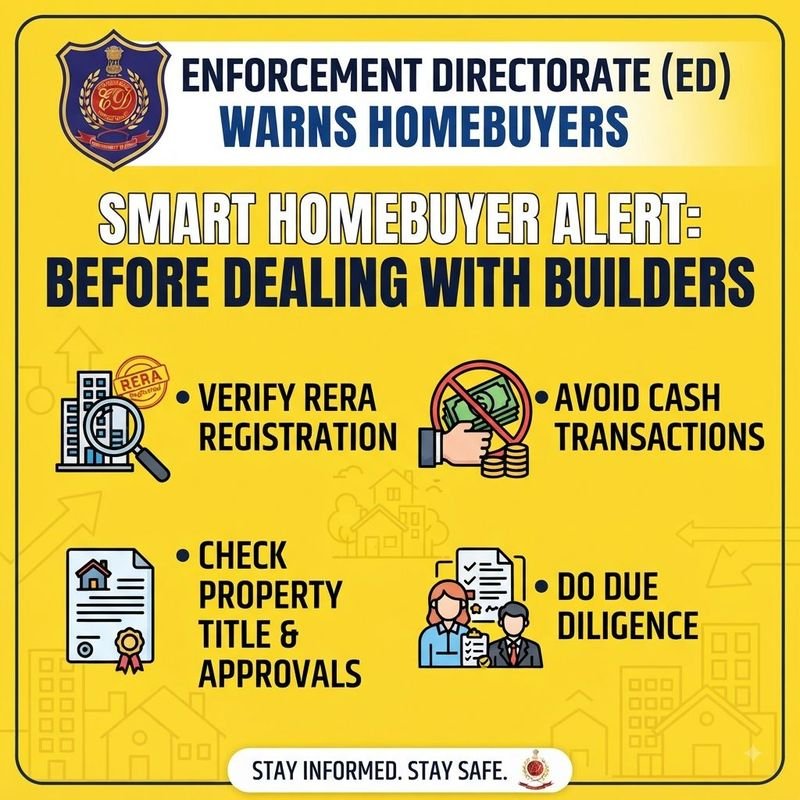
The Enforcement Directorate (ED) has issued an important warning for homebuyers, advising them to remain cautious when dealing with builders who refuse to share RERA registration details, demand cash payments, delay registered documentation or fail to refund money.
The advisory comes after the ED provisionally attached assets worth ₹129.80 crore belonging to an Ahmedabad-based real estate company and its promoters in an alleged homebuyer fraud case.
The warning highlights a crucial reality for property buyers: before making a substantial payment, it is essential to verify the legal and regulatory status of the project instead of relying solely on the assurances of a developer, broker or sales representative.
ED Flags Major Warning Signs for Homebuyers
According to the advisory, homebuyers should exercise caution if they encounter certain suspicious practices during a property transaction.
Some of the important warning signs include:
- Refusal to provide RERA registration details
- Demand for cash payments
- Delay in executing registered agreements or documents
- Failure to refund money after cancellation or withdrawal
- Reliance on oral assurances instead of written commitments
- Pressure to sign only booking forms or informal documents
- Unclear title or ownership of the land
- Undisclosed mortgages or encumbrances
- Guaranteed buyback or unusually attractive return promises
While the presence of one factor may not by itself establish fraud, a combination of such circumstances should prompt a buyer to conduct additional legal and regulatory verification.
What Is RERA and Why Is Registration Important?
The Real Estate (Regulation and Development) Act, 2016, commonly known as RERA, came into force on May 1, 2016.
The legislation was introduced to bring greater transparency, accountability and regulatory oversight to the real estate sector while protecting the interests of homebuyers.
Under Section 3 of the RERA Act, promoters are generally required to register qualifying real estate projects with the concerned State RERA Authority before advertising, marketing, booking or selling units.
However, certain projects may fall within statutory exemptions. These can include projects where:
- The proposed land area does not exceed 500 square metres, or
- The number of apartments does not exceed eight,
subject to the provisions of the Act and the applicable State Rules.
Therefore, the absence of a RERA registration number does not automatically mean that a project is fraudulent. But where registration is legally required, a promoter’s refusal to provide the registration details should be treated as a serious warning sign.
Do Not Rely Only on the Builder’s Word
The ED has cautioned buyers against relying exclusively on:
Oral promises, booking forms, notarised documents or assurances made by brokers or sales representatives.
A property purchase involves significant legal and financial consequences. Buyers should ensure that important promises relating to:
- Possession
- Amenities
- Refunds
- Area of the apartment
- Parking
- Buyback arrangements
- Construction timelines
are properly reflected in legally enforceable documents.
A verbal assurance from a salesperson may be difficult to establish later if a dispute arises.
Verify RERA Registration Before Paying
One of the first steps for a prospective buyer should be to check the official RERA portal of the State where the project is located.
The buyer should verify:
Project Registration
Check whether the project is registered and whether the registration remains valid.
Promoter Details
Verify the name of the promoter and compare it with the entity mentioned in the booking form, brochure and proposed agreement.
Completion Timeline
Check the completion date disclosed to RERA and compare it with the possession date promised by the developer.
Approved Project Details
Examine the information available regarding the project, including the number of buildings or units and other statutory disclosures.
Litigation and Encumbrances
Where such information is available or can otherwise be verified, buyers should check whether the property is subject to disputes, mortgages or other encumbrances.
Check Title Documents and Land Records
RERA registration alone should not be treated as a substitute for proper legal due diligence.
The ED has advised buyers to verify:
- Title documents
- Land ownership records
- Statutory approvals
- Encumbrance details
- Whether the property has been mortgaged
- Whether litigation is pending
A project may have multiple layers of legal documentation, and buyers should ensure that the developer has the necessary legal rights to develop and sell the property.
Cash Demands Are a Major Red Flag
The demand for a substantial cash component should make a buyer extremely cautious.
Property transactions should be properly documented, and payments should be capable of being traced through legitimate banking channels.
Cash demands can create serious problems for a buyer because they may:
- Leave inadequate proof of payment
- Create difficulties during legal proceedings
- Complicate refund claims
- Result in differences between the actual amount paid and the documented consideration
- Raise questions regarding the legality of the transaction
Buyers should preserve all bank transfer records, receipts, invoices and written payment acknowledgements.
Delayed Registration of Documents Can Create Serious Problems
Another warning sign identified in the advisory is the unnecessary delay in executing proper registered documents.
A buyer should understand exactly what document is being executed and what legal rights it creates.
Depending on the stage and nature of the transaction, this could involve an:
- Agreement for Sale
- Sale Deed
- Conveyance Deed
- Other legally relevant registered documents
Simply paying money or receiving an informal booking confirmation does not necessarily provide the same level of legal protection as a properly executed and enforceable document.
Failed Refunds Should Not Be Ignored
Homebuyers should also remain alert where a developer repeatedly promises a refund but fails to actually return the money.
This can become particularly serious where:
- A project is cancelled
- Construction does not commence
- Possession is substantially delayed
- The buyer validly withdraws from the project
- The promoter agrees to refund the amount but does not make payment
Buyers should preserve all written communications, including:
- Emails
- WhatsApp messages
- Demand letters
- Cancellation requests
- Refund promises
- Payment receipts
Such documents can become important evidence before the RERA Authority, consumer forum, civil court or other competent authority, depending on the facts of the case.
Guaranteed Buyback Offers Also Require Caution
The ED has also highlighted guaranteed buyback schemes and unusually attractive assurances as potential warning signs requiring careful scrutiny.
Before investing on the basis of such a promise, a buyer should ask:
Who is legally giving the guarantee?
Is the obligation recorded in the Agreement for Sale?
What are the conditions for exercising the buyback?
Does the promoter have the financial capacity to honour the commitment?
Is the promised return commercially realistic?
A glossy brochure or verbal assurance should not be treated as a substitute for a legally enforceable contractual obligation.
What Should You Do If a Builder Refuses to Share RERA Details?
If a builder refuses to provide RERA registration details, buyers should not immediately assume that fraud has occurred because the project may fall within an exemption.
However, the buyer should independently verify the position.
A practical approach would be:
Step 1: Stop Making Further Payments
Do not make additional payments until the legal and regulatory status of the project is verified.
Step 2: Check the State RERA Portal
Search for the project and promoter on the official RERA website of the relevant State.
Step 3: Verify Whether the Project Is Exempt
Determine whether the project falls within any exemption under the RERA Act and applicable State Rules.
Step 4: Examine Statutory Approvals
Check whether the project has the necessary planning and development approvals.
Step 5: Verify Land Title and Encumbrances
Ensure that the developer has clear legal rights over the land and determine whether the property is subject to any mortgage, charge or dispute.
Step 6: Insist on Proper Documentation
Avoid relying only on booking forms, notarised papers or oral commitments.
Step 7: Preserve Every Record
Keep copies of all advertisements, brochures, emails, WhatsApp communications, receipts and payment records.
Step 8: Approach the Appropriate Authority
Depending on the nature of the dispute, buyers may consider approaching the State RERA Authority or another competent authority.
Key Lesson for Homebuyers
The ED’s warning reinforces an important principle: property buyers should conduct verification before making payments, not after a dispute begins.
A buyer should ideally verify the following before committing substantial money:
RERA Registration → Project Approvals → Land Title → Encumbrances → Promoter Details → Agreement for Sale → Payment Trail
A few hours spent on due diligence can potentially prevent years of litigation.
Conclusion
The ED advisory following the attachment of ₹129.80 crore worth of assets in the alleged Ahmedabad homebuyer fraud case is a reminder that homebuyers must remain vigilant throughout the property purchase process.
A builder’s refusal to provide RERA details, insistence on cash, repeated delays in executing documents or failure to honour refund commitments should not be casually ignored.
While every project without a visible RERA number is not necessarily illegal or fraudulent, buyers should independently verify whether registration is required and whether the project has the necessary approvals and clear legal status.
The safest approach is simple: verify first, document every payment, insist on proper legal agreements and do not rely solely on verbal promises.